If this is your first visit, be sure to
check out the FAQ by clicking the
link above. You may have to register
before you can post: click the register link above to proceed. To start viewing messages,
select the forum that you want to visit from the selection below.
Innovative and dependable, the Self-Shifter replaced the conventional gearlever with an under-dash T-handle. Pushing the handle to "Forward" brought access to a pair of driving gears that changed automatically according to road speed. You pulled the handle halfway out for Neutral, all the way out for "emergency low," which also had two automatic ratios. For Reverse, turn the handle right, then pull out. The clutch pedal was used only for starting off. Nice though this was, the Self-Shifter attracted few buyers. But surprisingly, Reo's calendar-1934 car output was slightly higher at 4460, and truck sales jumped a startling 70 percent. Some experts cite the Self-Shifter's development cost as a key factor in Reo's demise, but management turmoil since the Great Crash also contributed. When Ransom Olds moved up to board chairman in 1923, new president Richard Scott greatly expanded production, which left Reo with money-losing excess capacity when the Depression severely shrunk the medium-price market.
At Old's insistence, Scott was replaced in 1930 by William Wilson, an executive of the Murray Body Company. But when Wilson couldn't halt the sales slide, Scott got another chance. That angered Olds, yet Scott's supporters were entrenched, prompting the founder to resign in December 1933. That shook up embattled Reo stockholders, who persuaded Olds to return the following April and elected Donald E. Bates as president. Hopes were high that things would turn around.
Meanwhile, the S-4 continued into 1935 as the little-changed S-5, and Eights gave way to a lowly S-7 Royale Six coupe and sedan, essentially S-5s with a 95-bhp engine selling for $985. Both were gone by early 1936, a sorry end for the once-mighty Royale.
But somehow, Reo managed yet another new Flying Cloud for 1935. Designated A-6, this offered two- and four-door Hayes-built fastback sedans with 115-inch wheelbase and a superior new 90-bhp 228-cid six with seven main bearings, aluminum head, automatic choke, and external vibration damper. Front styling vaguely recalled Auburn, with flared fenders and vee'd bumper. For all that, Ransom Olds disliked the A-6, calling its $450,000 tooling cost a waste of money.
But as at Olds Motor Works long before, his colleagues disagreed, and they pushed ahead for '36. They were doubtless encouraged by Reo's first profit in years, a slim $42,156 for the first half of 1935 on meager sales of cars and trucks. Still seeking to bolster income, the firm shared its body dies with erstwhile rival, Graham-Paige.
Reo announced "America's Finest Six" in November 1935, but it was just an A-6 with fuller fenders, rubber-tipped bumper guards, optional "Zeppelin-style" fender lamps, and a reworked hood and radiator wearing bright trim a la Pontiac's "Silver Streaks." The Self-Shifter was canned for conventional over-drive as a $50 extra for standard and DeLuxe models priced at $795-$895. But public confidence in Reo had nearly evaporated, so the firm built a mere 3206 cars that year, versus 4692 for calendar-year 1935.
With trucks now far more profitable than cars (the G-P deal had produced little revenue), the Reo board voted on May 18, 1936, to move truck assembly into the main Lansing plant; on September 3rd, Reo officially left the auto business. Though the company lost nearly $1.4 million on its 1936 cars, it was able to write off $604,000 for terminating its auto operations. Reo then turned exclusively to the truck field. Ironically, it would thrive there far longer than it had with cars, producing for the next 40 or so years under the Reo and Diamond-Reo nameplates.
لمازا تلك المشحمة راكبة للمساعدين ؟؟؟؟؟؟؟؟!!!
للمحافظة علي dust seal
واكس المساعد كمان نحافظ عليه من التجريح والخربشة ولو نقص المساعد زيت نكمله !!
يعنى ممكن يفضل يضرب فزيت ونكمله الى ان ربك يسهل الحال وصاحب العربية يشتريلها مساعدين جديدة !!
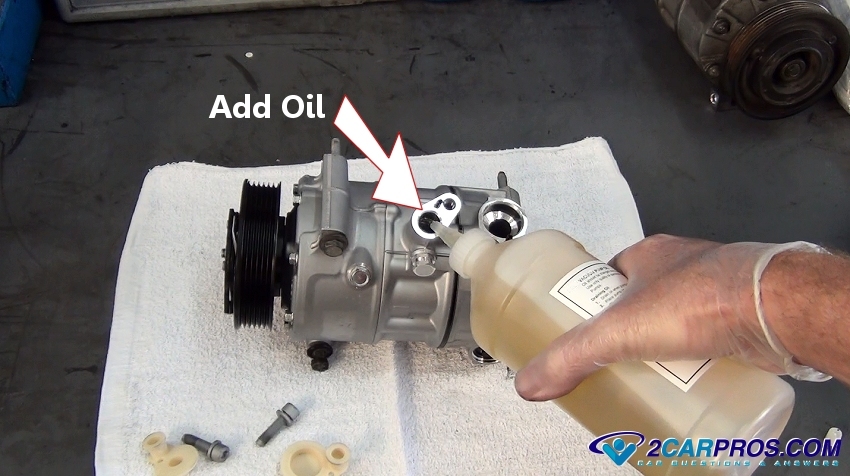
هتملى زيت بمشحمة زى الفيديو لكن بداخلها زيت مش شحم
ولو خراط شاطر يخرم بالشنيور وبالايرزوار يعمل سن مشحمة وتركب بدون فك المساعدين من مكانهم
اى بيض قبل ما تركبه وهو لسه جديد ضرورى توديه الاول لاءى خراط يعملهولك بمشاحم وبعدين تركبه !!
وكل شهر تروح البنزينة تشحمه وشوف عمر البيضات هيطول معاك قد ايه ؟؟؟؟؟؟؟؟؟!!او عند اى عفشجى او ميكانيكى عنده مسدس شحم!!
Everybody knows that Fluid Drive was Chrysler Corporation’s answer to Hydra-Matic, and that it goes “clunk” when it shifts. Everybody’s half right. Indeed, Fluid Drive, introduced on Chrysler cars for 1939 and extended to DeSoto and Dodge in 1941, was Chrysler’s weapon in the shiftless wars, arriving a year before Hydra-Matic and proving to be much more successful than the Reo Self Shifter and Lincoln’s ill-fated Liquimatic. But Fluid Drive doesn’t clunk – it doesn’t even shift.
That’s because Fluid Drive is simply a fluid flywheel, a concept employed by the British Daimler as early as 1933. As Chrysler explained it, a “driving wheel” attached to the engine is filled with a “special oil” (the fluid) which exerts force on a “runner wheel” that connects to the driveshaft (“Gyrol” refers to the “special oil;” the fluid couplings were developed in Germany). As the driver is spun faster and faster the runner turns with it, in a smooth application of power.
Instead of the repetitious routine of clutching and shifting a conventional car, one merely drops the Chrysler into high and steps on the gas. The result is a smooth getaway. Not just more convenient, it was safer, too – and easier on the car. This “cushion of power” was said to be trouble free – and thrilling. As thrilling, apparently, as driving a destroyer or a submarine. “Adopted in 1938” pertains to the 1939 model year, and the 1945 date on this brochure suggests that no innovation since 1915 was as noteworthy.
You note it says nothing about shifting. That’s because Fluid Drive, in its basic form, is just the fluid flywheel and a standard clutch. When ordered on a Dodge, that’s all you got. Drop it into third and go – smoothly but with destroyer-like acceleration. You did have to use the clutch, which Chrysler called a “Safety Clutch,” to get into gear, but afterwards all your driving was with your right foot. On Chrysler and DeSoto, though, it could be coupled to a transmission that shifted itself. This was actuated with vacuum, called Vacamatic by Chrysler and Simplimatic in DeSoto. There were two gears in each of two ranges, and the shift was actuated by lifting the throttle and waiting for the clunk. You could get Fluid Drive without Vacamatic/Simplimatic, but not vice versa.
After World War II, a new hydraulically-shifted transmission was used, designated “M5” (Vacamatic and Simplimatic were apparently M4; I don’t know what M1 to M3 were). Chrysler’s was called “Prestomatic,” DeSoto’s “Tip-Toe Shift,” but all else was the same. Interestingly, although “matic” was the industry-wide suffix for self-shifting, widely touted, Chrysler didn’t announce it on their cars. There were no Vac/Simpli/Presto/TipToe emblems. The cars simply said “Fluid Drive,” on Dodge’s rear bumper, DeSoto’s front fender and Chrysler’s stop lamp. DeSoto also put it on the glove box.
But wait, there’s more – only not right now. The story of Fluid Drive post-1948 will have to wait for another time.

 Tweet










Comment